
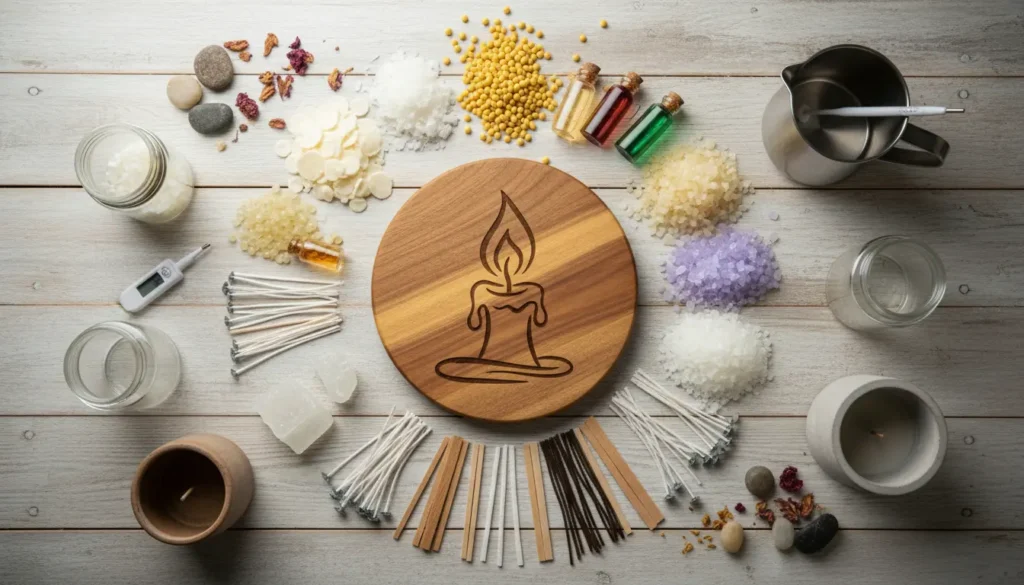
Making candles seems easy: we melt wax, add fragrance, place a wick, and pour. In practice, however, a quality candle depends on the right balance between wax, wick, fragrance, container, diameter, and working temperature.
There is no single "best" wax and no universal wick. There is a correct combination depending on what kind of candle we want to make: container, pillar, decorative, scented, natural, transparent, or luxury.
Important clarification: the temperatures below are approximate. Different brands and formulas have different recommendations, so it is always best to follow the instructions of the specific manufacturer. The National Candle Association states that the industry uses paraffin, soy wax, beeswax, palm wax, gel, synthetic waxes, and various blends.
1. Paraffin wax
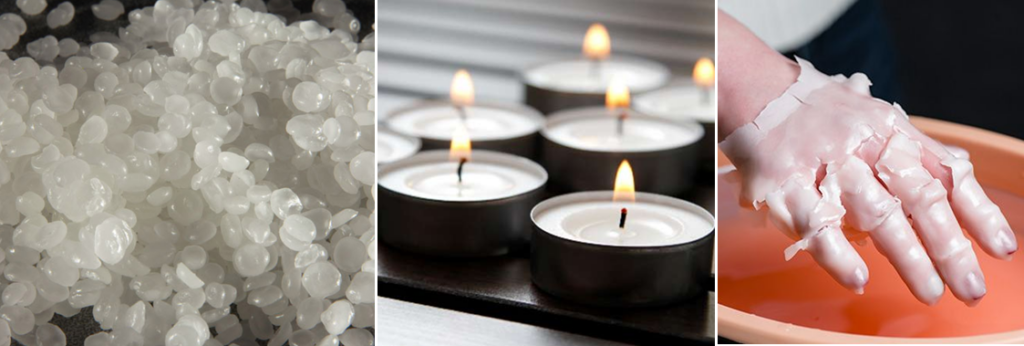
Paraffin wax is one of the most common waxes for candles. It is derived from petroleum raw material and is widely used because it is easy to work with, affordable, and a very good carrier of fragrance and color.
Melting temperature: usually around 46–68°C, depending on hardness and formula.
Temperature for adding fragrance: often around 75–85°C, but it depends on the type of paraffin and fragrance.
Pouring temperature: approximately 55–75°C, depending on whether it is for a container, mold, or pillar.
When to choose paraffin wax?
Paraffin is a good choice when we want a strongly scented candle, rich color, or easy handling for beginners. It is suitable for container candles, pillar candles, tealights, decorative shapes, and scented candles.
Advantages
- Retains and releases fragrance very well.
- Easily colored and gives bright colors.
- It has a smooth and beautiful finish.
- It is suitable for many different types of candles.
- It is usually more affordable in price.
Cons
- It is not a plant-based or natural wax.
- It can produce more soot with an improper wick.
- Some customers perceive it as a less "eco" choice.
Practical advice
With paraffin, it is very important that the wick is not too large. If the wick is thicker than necessary, the flame becomes high, the candle starts to smoke, and the walls of the container can become too hot. This does not mean that paraffin is "bad," but that the wax-wick combination is not correct.
2. Soy wax
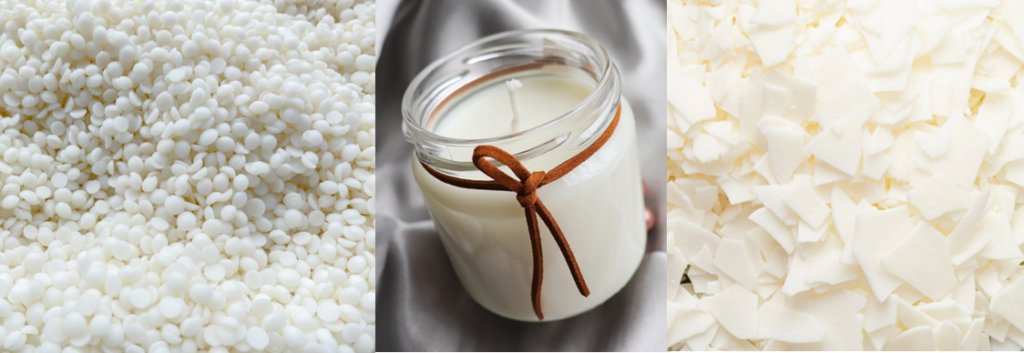
Soy wax is made from hydrogenated soybean oil. It is very popular for handmade candles because it is plant-based, burns slower, and has a softer, creamier appearance.
Important: soy wax is not just one type. There are soy wax for container candles and soy wax for pillar/molded candles. Container wax is usually softer and designed to stay in a jar or cup. Soy wax for pillars is harder and formulated so the candle can be removed from the mold and retain its shape.
Melting temperature: often around 45–55°C, but in some formulas it can be higher.
Temperature for adding fragrance: often around 75–85°C; CandleScience, for example, recommends 185°F / about 85°C for some popular soy waxes.
Pouring temperature: often around 50–70°C, depending on the formula; for some soy waxes it starts around 57°C and is adjusted according to the result.
When to choose soy wax?
Choose soy wax when you want a plant-based, cleaner-burning candle, especially for containers. It is very suitable for jars, cups, and scented home candles.
However, soy wax for pillar candles should be used soy wax for molds, not standard soft soy wax for containers.
Advantages
- Plant-based.
- Burns slower than many other waxes.
- Suitable for natural positioning.
- Easily cleaned with warm water and soap.
- A good choice for container candles.
Cons
- Can form “frosting” — white crystalline spots.
- More sensitive to pouring temperature.
- Sometimes there is a weaker aromatic intensity than paraffin.
- It may create uneven or rough tops.
Practical advice
If the soy candle has an uneven surface after cooling, the cause is often thermal shock or inappropriate pouring temperature. Soy wax crystallizes in its own way and this can give white spots or a rough finish. Therefore, it is important to work calmly with it: not to overheat excessively, to stir the fragrance well, and to test the pouring temperature.
3. Beeswax
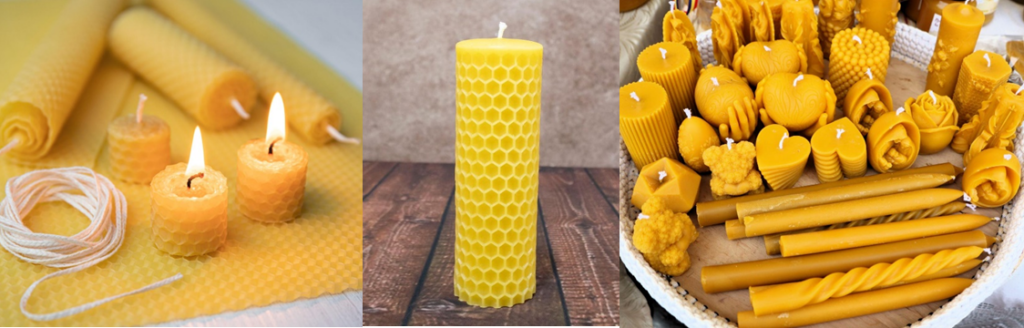
Beeswax is one of the oldest waxes used for candles. It is a natural product, has a characteristic light honey scent, and higher hardness.
Melting temperature: about 62–65°C.
Temperature for adding fragrance: approximately around 70–80°C, but with beeswax the fragrance is often dosed carefully because the wax itself has its own smell.
Pouring temperature: approximately 65–80°C, depending on the shape and the mixture.
When to choose beeswax?
It is suitable for people looking for a natural, long-lasting, and classic candle. It is often used for pillar candles, church candles, taper candles, decorative candles, and rolled candles made from wax sheets.
Advantages
- Natural wax.
- Burns long.
- Has a pleasant natural scent.
- Suitable for unscented candles.
- Produces a hard and stable candle.
Cons
- More expensive.
- Harder to color.
- Its own scent can blend with the added fragrance.
- Requires more careful wick selection.
Practical advice
Beeswax usually needs a stronger wick than soy wax because it is denser and has a higher melting point. If the wick is weak, it will not melt enough wax around it, and the candle may start tunneling.
4. Coconut Wax
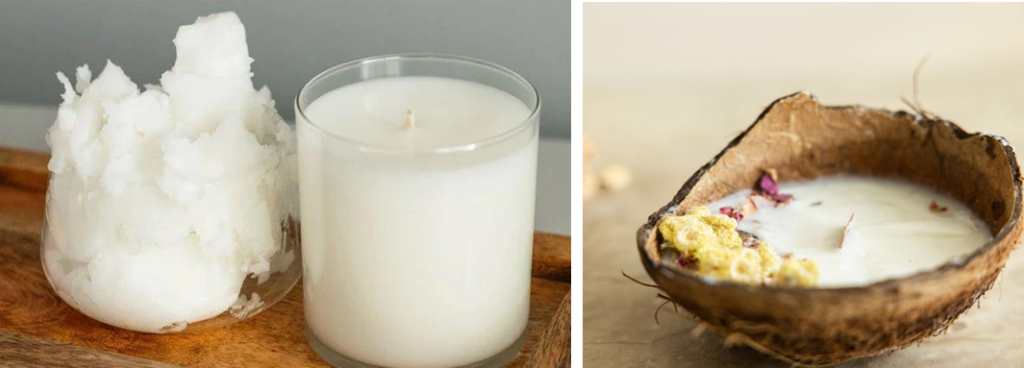
Coconut wax is a soft, creamy wax derived from coconut oil. It is usually used in blends because on its own it is too soft for many applications.
Melting temperature: often around 35–45°C, but in coconut blends it can be higher.
Temperature for adding fragrance: often around 75–90°C, depending on the blend. For some coconut-soy blends, manufacturers recommend heating to about 85–88°C and pouring around 74–79°C.
Pouring temperature: approximately 55–80°C, depending on the specific blend.
When to choose coconut wax?
Choose it for more luxurious container candles when you want a creamy look, good scent throw, and slow burning. It is most commonly found as a coconut-soy, coconut-paraffin, or coconut-rapeseed blend.
Advantages
- Very beautiful, smooth, and creamy appearance.
- Excellent for combining with fragrances.
- Suitable for premium candles.
- Often burns slowly and evenly.
Cons
- More expensive.
- Very soft if used alone.
- Usually requires mixing with another wax.
- Temperatures strongly depend on the specific formula.
Practical advice
For coconut blends, do not use a "universal" temperature from the internet. A coconut-soy blend may behave differently from a coconut-paraffin one. If the wax is very soft, an excessively large wick can quickly create a deep melt pool and cause the candle to burn too fast.
5. Palm wax
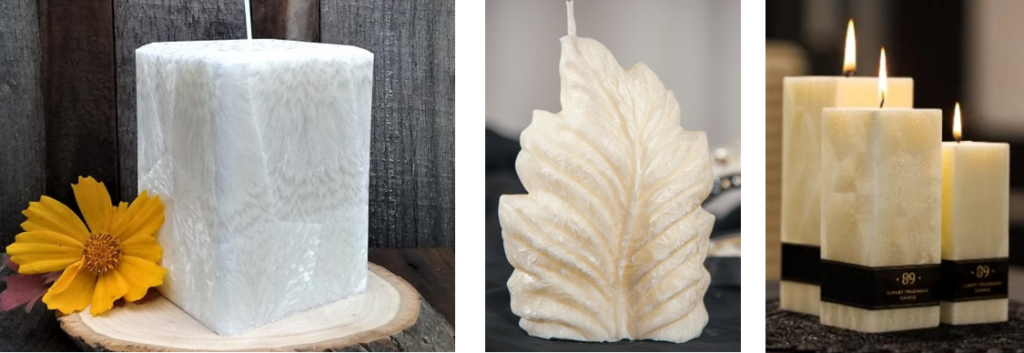
Palm wax is obtained from hydrogenated palm oil. It is hard and known for beautiful crystalline, "pearly," or "frosty" effects.
Melting temperature: often around 55–65°C, depending on the formula.
Temperature for adding fragrance: approximately 80–90°C.
Pouring temperature: often higher — around 80–95°C, because the crystalline effect depends on the cooling method.
When to choose palm wax?
It is suitable for decorative, pillar, and molded candles when a special texture is desired. It is not the first choice for complete beginners because the final effect depends on the temperature, mold, and cooling.
Advantages
- Very beautiful decorative effect.
- Hard and stable.
- Suitable for pillars and molds.
- Visually distinct from other waxes.
Cons
- More demanding to work with.
- Not ideal for every fragrance.
- There are ethical and environmental issues surrounding palm oil extraction.
- Requires testing.
Practical advice
If the goal is a beautiful crystalline effect, do not cool the candle abruptly. In palm wax, crystals form with controlled cooling. If the pouring or cooling temperature is not appropriate, the effect may be weak or uneven.
6. Gel wax
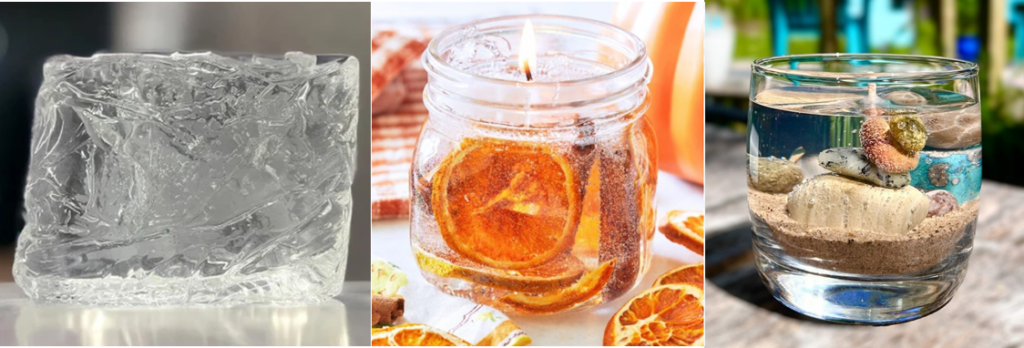
Gel wax is not wax in the classical sense. It is a transparent gel-like material, usually based on mineral oil and polymer resin. It is used for decorative transparent candles.
Melting/working temperature: often around 80–95°C, sometimes higher depending on the gel.
Temperature for adding fragrance: usually around 85–95°C, but the scent must be suitable for gel.
Pouring temperature: approximately 85–100°C, depending on the desired effect and bubbles.
When to choose gel wax?
Choose it for transparent decorative candles, marine themes, candles with elements inside, “water” effect, or artistic designs.
Advantages
- Transparent effect.
- Very decorative.
- Allows embedding of non-flammable decorative elements.
- Suitable for themed candles.
Cons
- Not every fragrance is suitable.
- Not all colorants are suitable.
- Requires attention to safety.
- More difficult for beginners.
Practical advice
For gel wax, only fragrances and colorants suitable for gel should be used. Unsuitable additives can cloud the gel, separate, or affect burning safety.
7. Rapeseed wax
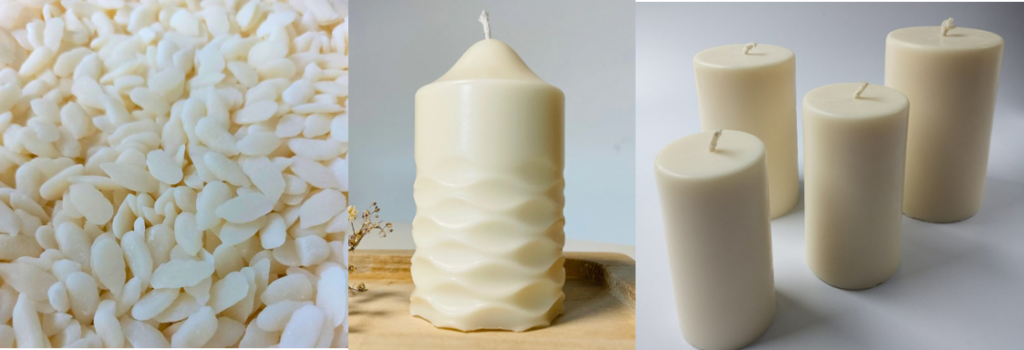
Rapeseed wax is produced from rapeseed oil and is popular mainly in Europe. It is often used as a more local plant-based alternative to soy wax.
Melting temperature: approximately 45–60°C, depending on whether it is for a container or pillar.
Temperature for adding fragrance: often around 70–85°C.
Pouring temperature: approximately 50–75°C, depending on the formula.
When to choose rapeseed wax?
Suitable for plant-based candles, especially when looking for a European alternative. There are options for container and molded candles, as well as blends with coconut, soy, or other waxes.
Advantages
- Plant-based.
- Popular in Europe.
- Can have good burning and a good fragrance profile.
- Available in different formulas.
Cons
- Less known than soy wax.
- Not all suppliers offer it.
- May require more wick testing.
- Different formulas behave differently.
Practical advice
Do not take rapeseed wax as "the same as soy." Both are plant-based, but their structure and behavior when burning are different. Therefore, a wick that works well in soy wax may not give the same result in rapeseed.
8. Blended Waxes
Blended waxes combine two or more waxes, for example:
- soy + coconut;
- soy + paraffin;
- coconut + rapeseed;
- paraffin + microcrystalline wax;
- beeswax + plant wax.
The goal is to combine the advantages of different waxes: better scent, smoother surface, better burning, less frosting, easier handling, or more stable shape.
Melting temperature: very different — often around 45–70°C.
Temperature for adding fragrance: usually around 75–90°C, according to the manufacturer.
Pouring temperature: approximately 50–85°C, according to the blend.
When to choose a blended wax?
Choose a blend when you want a more balanced result. For example, soy-coconut blends are often used for luxury container candles, and paraffin-soy blends can provide a better scent than pure soy and a more pleasant "natural" feel than pure paraffin.
Advantages
- More balanced performance.
- Often better surface.
- May have better scent throw.
- Easier to adjust for a specific type of candle.
Cons
- There are no universal rules.
- Temperatures depend heavily on the formula.
- Requires wick testing.
- Sometimes the composition is not entirely clear.
Practical advice
For blends, the most important thing is to follow the manufacturer's instructions. If a soy wax pours well at 55–60°C, it does not mean that a soy-coconut blend will behave the same way.
Types of candle wicks
The wick is the "engine" of the candle. It draws the melted wax up to the flame. If it is too thin, the candle tunnels. If it is too thick, the flame becomes large, the candle smokes, and burns too quickly.
1. Cotton wicks
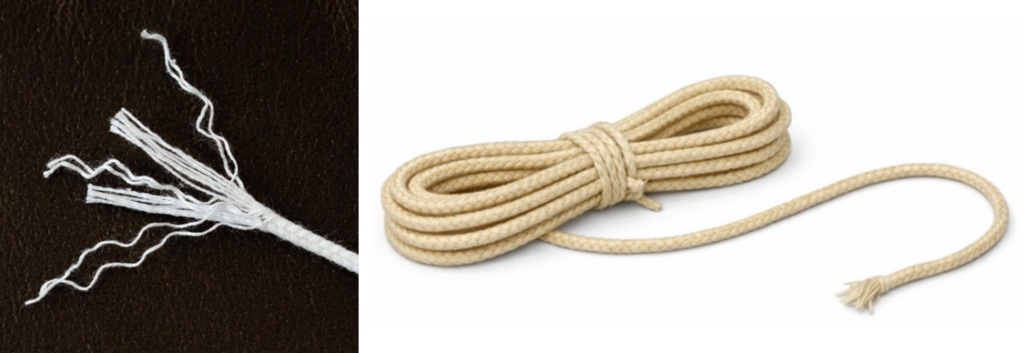
Cotton wicks are the most common. They can be braided in different ways and designed for different waxes.
When to choose them?
Suitable for almost all types of candles: soy, paraffin, beeswax, rapeseed, coconut blends, and mixtures. For beginners, this is the most logical start.
Advantages
- Universal.
- Easy to work with.
- Available in many sizes.
- Suitable for container and molded candles.
Cons
- The size needs to be tested.
- The same wick does not work the same in all waxes.
- The wrong size can cause smoking or tunneling.
Tip
Start with the recommended size according to the diameter of the vessel, but always perform a test burn. The diameter is only a starting point. The type of wax, fragrance, and dye also affect the burn.
2. Paraffin-coated wicks
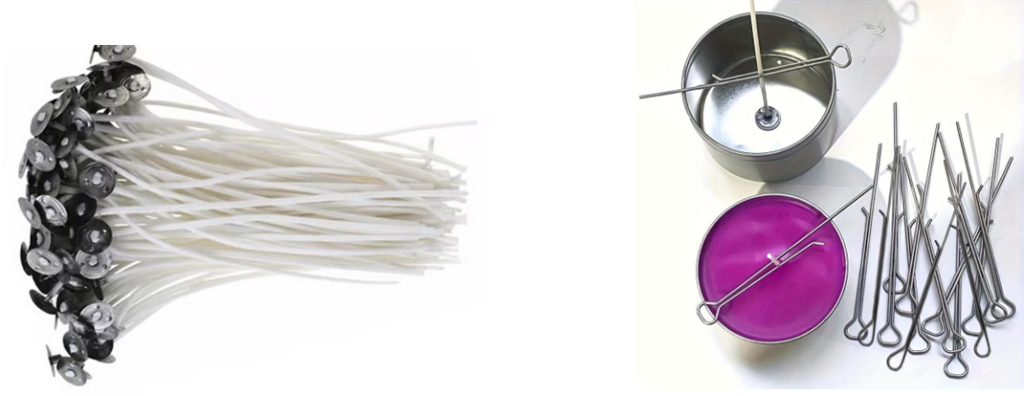
Paraffin-coated wicks are cotton or other types of wicks pre-coated with a thin layer of paraffin or wax blend.
When to choose them?
Very suitable for beginners are container candles, tealight candles, and standard scented candles. The pre-coating makes the wick more stable and easier to place.
Advantages
- They are easier to center.
- They burn more steadily at the beginning.
- They are more convenient to work with.
- They often come with a metal plate.
Cons
- They are not ideal for people looking for a 100% plant-based/vegan formula if the coating is paraffin.
- They do not solve the problem of the wrong size.
- They may not be suitable for specific natural candles.
Tip
A paraffin-coated wick does not automatically mean a "correct wick." It only facilitates the work. The size still needs to correspond to the wax, diameter, and fragrance.
3. Wooden wicks
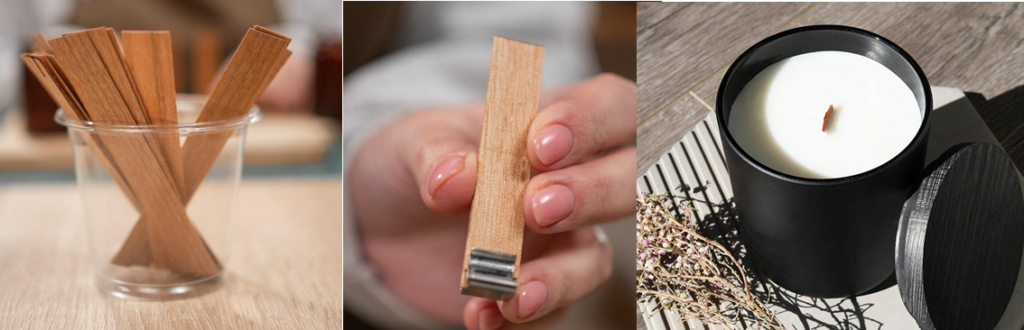
Wooden wicks are thin wooden strips or combined wooden wicks that often produce a light crackling sound when burning.
When to choose them?
They are suitable for decorative and luxury container candles. They are chosen when, besides fragrance, an effect is desired — sound, appearance, a feeling of coziness.
Advantages
- Beautiful and modern look.
- Light crackling effect.
- Suitable for premium candles.
- Provide a different user experience.
Cons
- They are more demanding.
- They can go out if the size is inappropriate.
- They do not work well with every wax.
- Require proper trimming.
Tip
The wooden wick should be trimmed low — often around 3–5 mm. If it is too tall, it may burn unstably; if it is too weak for the wax, it will not maintain enough heat and will go out.
4. Paper core wicks
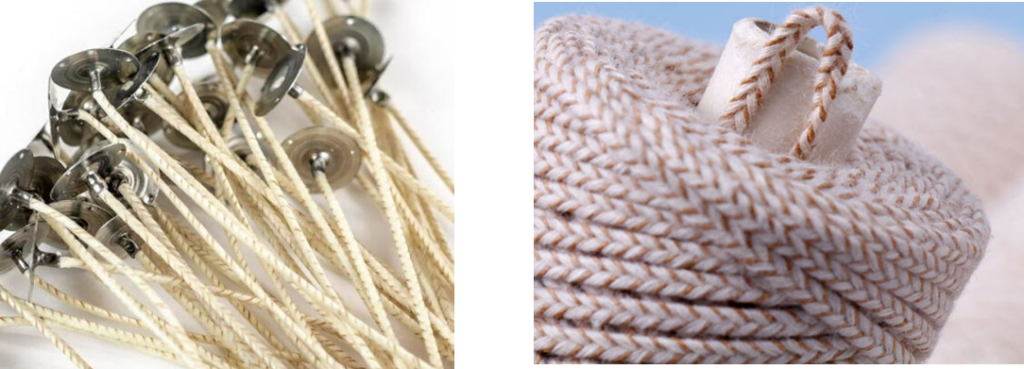
These are wicks where the cotton is reinforced with a paper thread. The goal is for the wick to stand more upright and provide a more stable flame.
When to choose them?
Suitable for container candles and waxes that require a slightly more stable burn. Often used with plant-based waxes and blends.
Advantages
- Good stability.
- Suitable for containers.
- Can help with more viscous waxes.
- Easier to maintain a flame.
Cons
- Not universal.
- If the size is wrong, they can smoke.
- They need to be tested with the specific wax.
Tip
If the candle tunnels with a regular cotton wick, the solution is not always "a much thicker wick." Sometimes a more suitable wick construction gives a better result than simply increasing the size.
5. Wicks with a metal core
These wicks have a metal thread that helps the wick stand upright. They were more commonly used in the past, but today many manufacturers avoid certain metal cores.
When to choose them?
They are less commonly used in modern handmade production. They can be found in specific candles, but for beginners, there are usually better alternatives.
Advantages
- They stand firmly upright.
- They can work in some special applications.
Cons
- They are not the first choice for natural candles.
- Care must be taken with quality and composition.
- They are less preferred by hobby producers.
- They are hard to find.
Tip
For beginners, it is better to start with cotton, paraffin-coated, or wooden wicks instead of metal-core ones.
How to choose the right wick?
The most important factors are:
- Diameter of the container or candle
The wider the candle, the more heat is needed to melt the wax to the walls. - Type of wax
Beeswax and palm wax usually require a stronger wick than soft container waxes. - Fragrance oil
Some fragrances "weigh down" the burn. A high fragrance load may require a different wick. - Dye
Too much dye can clog the wick and worsen the burning. - Candle type
Container, pillar, and decorative candles have different needs.
What does the wrong wick look like?
The wick is too small if:
- the candle tunnels;
- the flame is weak;
- a lot of wax remains on the walls;
- the candle goes out by itself.
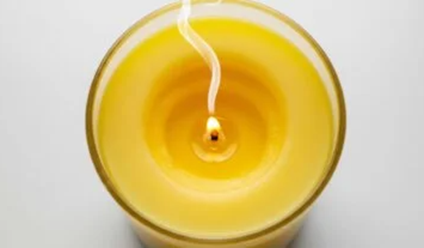
The wick is too large if:
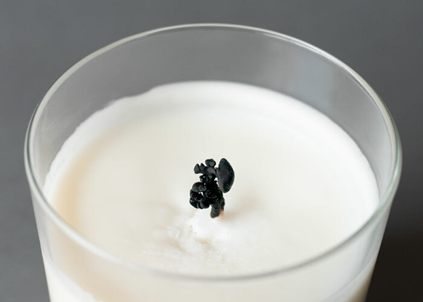
- the flame is very high;
- there is smoke;
- the container becomes too hot;
- the wax melts too quickly;
- the wick forms a large "mushroom" at the tip.
Conclusion
There is no universal recipe for candles. The same wax can behave differently depending on the manufacturer, fragrance oil, container, wick, and working temperature.
The best approach for beginners is:
- to start with wax suitable for the specific candle;
- to use a recommended wick as a starting point;
- to make small test batches;
- to record melting temperature, adding fragrance, pouring, and result;
- to do a test burn for at least a few hours.
A candle is not just wax and wick. It is a balance between materials, temperature, and proper testing.